

Description
Kindly note that the ebook version is coming soon.
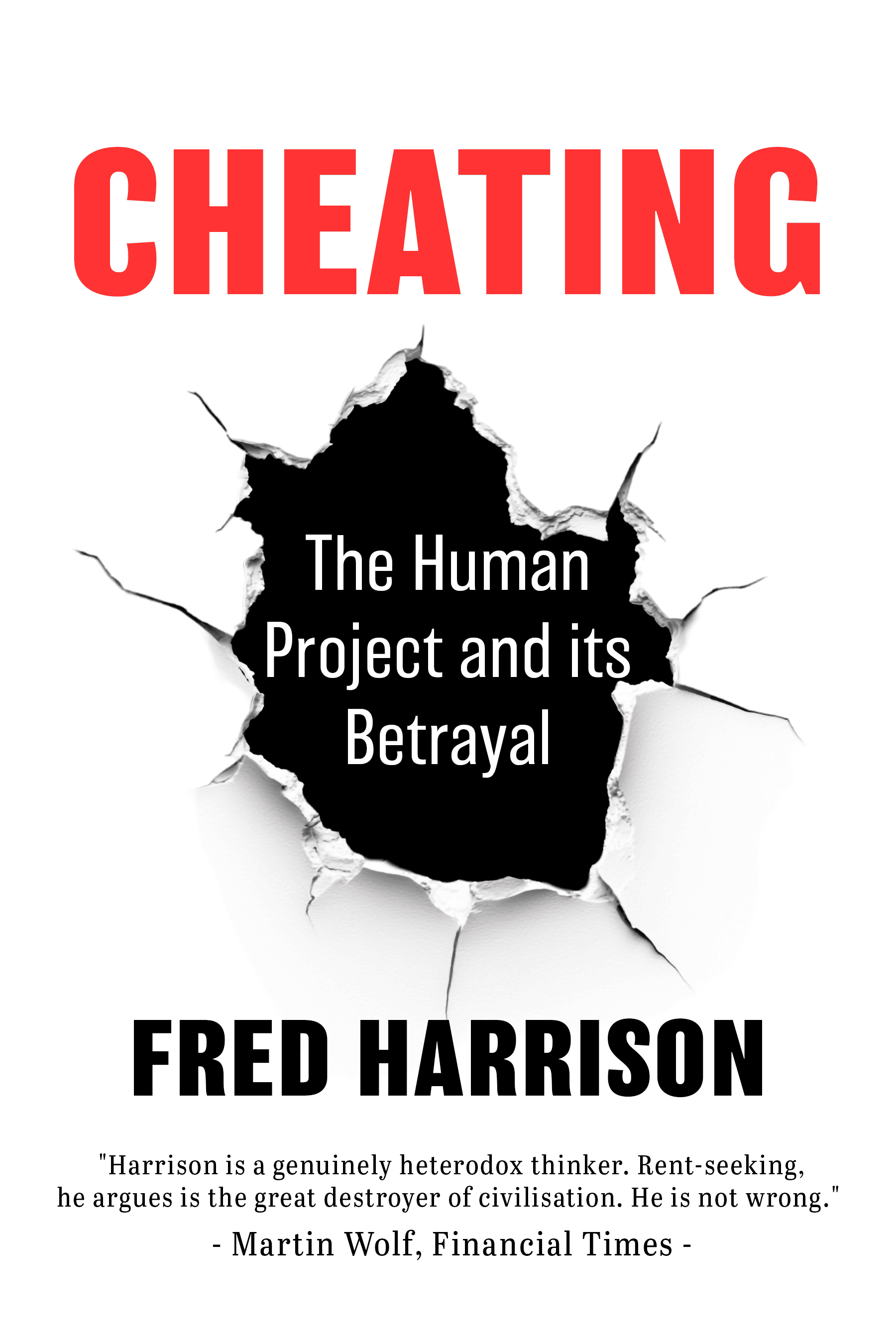
Five thousand years ago, humanity made a huge mistake. The income generated from shared land, known as economic rent, was taken by chiefs and priests instead of being used for everyone’s benefit.
Every unfair tax, every preventable death from poverty, and every financial crash since can be traced back to this original betrayal. Drawing on evolutionary science and years of accurate economic predictions, including the 2008 financial crisis, Fred Harrison reveals the “culture of cheating” built into the foundations of modern society.
He explains how mainstream economics deliberately removed the idea of rent and how governments choose to tax wages instead of land, harming prosperity and shortening lives. With five major crises: political gridlock, environmental collapse, mass migration, authoritarianism, and uncontrolled artificial intelligence, set to clash around 2028, Harrison makes an evidence-based case for tax reform: replacing taxes on labour with Annual Ground Rents and sharing rents between nations to resolve conflicts from Gaza to the global climate crisis.
Thought-provoking and rigorous, this book confronts why civilisations fail and offers a plan to prevent the next collapse.
ABOUT THE AUTHOR
Fred Harrison is a British author, economist, Research Director of the Land Research Trust, and former investigative journalist, renowned for his theories on land-based economic cycles. He is best known for developing the 18-year property cycle and correctly predicting the major economic crashes of 1990 and 2008. A graduate of Oxford and the University of London, he has advised governments, think-tanks, and international organisations on fiscal reform, land value taxation, and economic development for over four decades. His work has been cited in parliamentary debates and translated into multiple languages. He lives in London.
REVIEWS
‘The proposal in this book to shift the bulk of taxation from incomes and profits to a Land Valuation Tax, or more broadly to a fiscal charge on society’s net income, or rent, as the author would put it, is absolutely correct, and has now become necessary in order to deal with the parlous state of fiscal policy. But that leaves open the question of how far this reform can of itself lead to a diminution of the pursuit of power and other forms of social ‘Cheating’.”
—Charles Goodhart, Emeritus Professor of Banking and Finance, London School of Economics
“Fred Harrison is right. We have developed a culture of cheating. If people grapple with the questions that Fred Harrison addresses, they may realize that the only path to a peaceful and prosperous world lies in sharing the Earth’s rent, so that all people are accorded equal rights to the natural opportunities provided by the Earth.”
—Nicolaus Tideman, Professor of Economics, Virginia Tech
“Harrison exposes a flaw in our system that enables Cheaters to demand tribute for access to the resources we all need to survive. Harrison’s hope is that by spreading awareness of the difference between the value of socially shared Rent and privatized Rent, we will be able to prevent the next predicted collapse. In Harrison’s words, nothing less is at stake than assuring “…our place on Planet Earth.”
—Dr. Heather Remoff, Anthropologist, Heather Remoff, author, What’s Sex Got to Do with It? Darwin, Love, Lust, and the Anthropocene
“Harrison traces how the evolutionary human project has been periodically interrupted not only by natural catastrophes but also by an unnatural human culture of cheating. This contravenes the moral maxim: “Keep what you make; pay for what you take.” This requires we trade at prices that reflect relative labour costs. Land qua land, as distinct from man-made capital goods, itself has no labour cost yet can exchange at vastly different prices and rents. These rents are effectively stolen from society that creates the relative advantages of different locations. Harrison explains why this pervasive injustice underlies worldwide conflict and why radical fiscal reform is needed to save civilisation itself.”
— Roger Sandilands, Emeritus Professor of Economics, Strathclyde University
This ambitious work is the culmination of a lifetime dedicated to advancing the human project. Its arguments are fertile ground for further scholarship, and its challenge is clear: a new generation must take up and advance the cause so fiercely championed by Harrison for so long.
— Akhil Patel, author of The Secret Wealth Advantage
Harrison masterfully uses insightful historical analysis to show that the current fiscal system is not only not “normal” and inevitable, but also why it is not normal: rent seekers have managed to divert socially owned economic Rent to their private pockets through privatisation.
Since something must and will change, Harrison’s book is the vehicle through which informed conversations can direct initiatives towards those that are both fair and economically sound. He explains how fairness and economic efficiency – Zero Deadweight losses – can be achieved by the simple pricing system of “keep what you create, pay for what you receive”.
—Jean-Pierre Zigrand, Co-director of the Systemic Risk Centre, and Associate Professor of Finance, London School of Economics
Fred Harrison’s Cheating: The Human Project and Its Betrayal is as provocative as it is illuminating—a book that doesn’t let the reader off the hook easily. With striking clarity, Harrison shows how mainstream economics has quietly edged the classical concept of economic rent out of view—conveniently leaving us with a system that taxes work and productivity, while largely sparing unearned gains from land. He argues, with characteristic sharpness, that this shift lies at the heart of recurring crises and persistent structural imbalances.
His case is further strengthened by decades of work on property cycles. Harrison is among the few economists who not only identified the recurring dynamics of land and real estate markets but also had the conviction to point to their crisis potential ahead of time. The fact that this perspective has proven remarkably prescient lends additional weight to his current analysis.
Yet Cheating is not merely diagnostic. Harrison sketches a bold and original reform perspective: the systematic capture of land and resource rents—conceived even at a global level—opens up new ways of thinking about economic stability, distributional justice, and even geopolitical tensions. The economic potential implied by such a reordering is substantial, and at the very least challenges deeply entrenched assumptions.
There is also a palpable sense of urgency running through the book. Harrison makes it clear that the window for meaningful reform may be limited. His argument that the opportunity for voluntary adjustment will not remain open indefinitely adds a certain tension to the reading experience—as if, alongside the analysis, a quiet countdown were ticking in the background.
Cheating is therefore far more than another contribution to economic debate. It is a thoughtful, incisive, and at times refreshingly uncomfortable intervention into the question of why our economies repeatedly falter—and what it might take to finally set them on a more stable footing.
—Dirk Löhr is an economist at Trier University of Applied Sciences and a leading advocate of the land value tax, which he helped to introduce in Baden-Württemberg, Germany.